Showing posts with label digital books. Show all posts

Saturday, July 23, 2011

New Paths in Library Advocacy: Reflections on the NC Teaching Fellows Jr. Conference

Today I had the amazing opportunity to work with some of my state's most valuable resources: new teachers.  The students in the classes I taught today were (roughly) one year away from completing their teacher education program as part of the NC Teaching Fellows Program.  (An aside, our legislature voted to zero out funding for Teaching Fellows this year - a travesty you can learn more about here). 

I've been nervous and excited about these presentations for weeks now.  Nervous because it always feels a little strange to play to an audience outside of libraryland and excited because I often wish my own teacher education program had offered the opportunity learn from and about school library media specialists and how they could help me (as a classroom teacher) and my students. To this day, although (in general) I feel like my own teacher education program perpared me fairly well for what I would experience in the classroom, I don't think I'm alone in the lamenting the lack of emphasis on the instructional team I would NEED to be a part of in order to truly provide my students with everything they would need. Indeed, I can't remember anyone talking to me about the school librarian and what he/she could do for me (my kids).

And so, to be honest, I couldn't wait to get in the room with these eager, fresh faced, soon to be teachers - if for no other reason that I felt I had a golden opportunity to fill a gap for them that was not, until much, much later, filled for me.   Advocacy is a topic that seems to be on the tip of every school librarian's tongue these days.  To that end, while I think many of us are becoming quite savvy when it comes to sharing what we do with those who have the power to impact our budgets and positions, I fear we may be missing the boat when it comes to embedding ourselves in education of the next generation of teachers/admininistrators.


In the end, however, I can't help but think that I got just as much (if not more) out of the experience than they did.  While I feel the sessions went well and I received great feedback afterwards, between the two of us, I feel like the big winner. Not only were the students funny and smart, they asked great questions, were willing to try new things and were filled with that new teacher spark - the perfect mixture of idealism, optimism and the unstoppable drive to make a difference. Ah... if only I could bottle that spark.  I'd keep most of it in a special, glass case labeled "In Case of Emergency." The rest I'd load into a one of the supersoaker squirt guns and take aim at those people we ALL work with who really need a good soaking. But I digress.  Even without the bottle (and squirtgun), I couldn't help but feel nostalgic being around them. Nostaligic and inspired.  As much as I hope I was able to help shape the image that these "youngsters" (I nearly cried when the second section informed me they were not alive when I was in middle school) will have of school librarians when they land in their first classrooms, the shape of my world was changed too by their contagious energy and endless enthusiasm - just a little of which rubbed off on me.

The following are my presentations from today's sessions.  As always, everything posted here is free for you to use, share and make better.


PS: Thanks so much to everyone who contributed to these presentations!  Your input proved invaluable!  Here's some proof: 

Future teacher:  "Will this symbaloo be available after this session?"
Me:  "Yes. It will be available forever."
FT:  "Really???"
Me:  "Yes."
FT:  "Really???"
Me:  "Yes."
FT:  "Thank you! Thank you! Oh Thank you!"

Tuesday, June 28, 2011

5 Conversations [About Libraries] I Don't Want To Have Anymore

The other day I ran across this post about educational conversations that have run their course. That is to say, ed-chat (not to be confused with #edchat) topics of discussion that have been discussed to death. We've all heard of educational "sacred cows," well... these are their "dead horse" companions. Naturally, this got me thinking about a similar list of library related conversations that I am tired of having. Don't get me wrong, I've spent plenty of time talking about these things myself and will probably be roped into talking about them again. What's more, I am not at all sitting in judgment of those for whom these issues remain compelling and important. Listen, if you're actively involved in dialogue about libraries, education and how librarians serve the needs of students, to you I tip my hat and say a hearty "bravo!" It's just, I guess I'm ready to see these conversations evolve. For me, at least, it’s time to either move these conversations to the next level, or send them out to pasture. Ok. Here goes:

  1. I don't want to talk about copyright anymore. Rather, I want to talk about creative commons, "thanktribution" and the importance of sharing expertise and resources to make, not only better products, but ultimately a better society too. Without question, it's still important to help kids understand that lots of people make their livings and feed their families from the work they create and, as such, have the right to ask for compensation/attribution. However, I find conversations with kids about the process of creating and choosing to share and/or license their own work to be far more meaningful. Rather than just telling kids it's wrong to steal, I'd like to see this conversation move towards helping students add their own works to the collective while also empowering them to license those works in the most appropriate way.
  2. I don't want to talk about "21st Century Skills" anymore. Seriously. It seems like I can't be involved with any educational conversation these days without being hit with the importance of 21st Century Skills. That's fine, but I'm ready to talk more specifically about what these skills really are. I want to see school librarians initiating and engaged in conversation that both identify specific skill sets and acknowledge that while the information landscape, and indeed the world, has certainly changed since the last century, many of the skills we should feel most compelled to develop in our students, (content curation, global awareness/citizenship, the ethical use/creation of information, etc.), are not exclusive to the 21st century. “21st Century Skills” is a convenient turn of phrase and, at one time, an impactful one. But that time has passed. Let’s move beyond the label and on to identifying, prioritizing and teaching the skills that will best prepare our students for life in this century and beyond. (Yes, they are going to live a very long time).
  3. I don't want to talk about the "digital divide" anymore. Okay, that's not really true. The digital divide is an issue that is important and that needs to remain a part of our collective conversation. HOWEVER, I want this conversation to move beyond issues of simple access. There is no question in my mind that access is important. Having spent much of my career working with students for whom school is the only connected, digital space they inhabit, I understand how access and equity go hand in hand. Still, if there's one thing my time at the reference desk of the public library has taught me, it's that ONLY providing people with access to computers/the internet is not enough. Our efforts to put computers in the homes of families who don't have them, to start "one to one" initiatives at schools with high populations of students with limited/no access beyond the school day, or the ever ambitious (and noble) goal of extending broadband access to areas where there is none, will only be effective if we couple them with instruction. It may seem as though our students are born with digital devices in their hands, but that doesn't mean they know how to use them. I want to see school librarians leading the charge to shape future conversations about the "digital divide" to include an emphasis on both access and education.
  4. I don’t want to talk about eBooks replacing print books anymore. I don’t believe this is going to happen. And it’s not because I’m a romantic who believes nostalgia will win the day. Rather, it’s because I understand that once the dust settles and the “new gadget” effect has worn off, schools will ultimately spend their limited monies on the resources that most impact student learning. To that end, I don’t just want to see school librarians acting as the voice of reason in these conversations, I want to see them emerge as curriculum and technology experts who understand that there’s room on the library shelves, and in student backpacks, for both traditional print and e-ink titles because both options address different instructional goals. In the end, I want to see this conversation become part of a larger, more important, dialogue revolving around how to best meet student needs – and this, my friends, is the conversation we should all be clamoring to be a part of.
  5. I don’t want to talk about protecting students from the evils of social media anymore. If any conversation on this list needs to evolve, it’s this one. Conversations or initiatives that seek to make a student’s digital footprint invisible are outmoded and, frankly, dangerous. Our students live in a digital, connected world. As fast as we think of ways to block social media, they figure out ways to circumvent the filter. This conversation must evolve to the point where our goal is to help students develop a safe and responsible online presence. As school librarians, I want to us to ask more questions like “what happens when a teacher is not there to keep a child from visiting a “bad” site?” Or “what happens when students are asked to submit personal information for an online profile, but they’ve never been taught how?” Or even better, “how can we expect students to make good choices when we’re not there, when they’re given NO choices when we are?” Filters are necessary. But conversations about helping students create a safe online presence, (one that allows them to take advantage of all the GOOD social media has to offer), are important too.
Since starting this post, I've placed and deleted this image multiple times. I keep changing my mind because I’m not sure the connection between this work of art (by graffiti artist Borf) and my thinking is clear. In the end, I worry about the conversations we are having in education. Not because I feel they are the wrong ones to be had or because I’m afraid the wrong people are having them.  In fact, if I'm honest, then in general I'm heartened by the amount of discussion that's being generated by and about educators/education these days.  School librarians have long been part of the quiet and polite crowd in the corner, heads down, doing our work, but not making a big fuss about it, so... believe me when I'm say I'm thrilled to see so many of my tribe kicking up the dust and (dare I say it?) showing off. If anything, I'm just nudging the conversation forward a little, because I, for one, am ready to see certain conversations evolve to a point of greater relevancy - lest they (and we) become obsolete.

Saturday, April 30, 2011

Diving Into Digital Books: TL Virtual Cafe Webinar Coming Up!

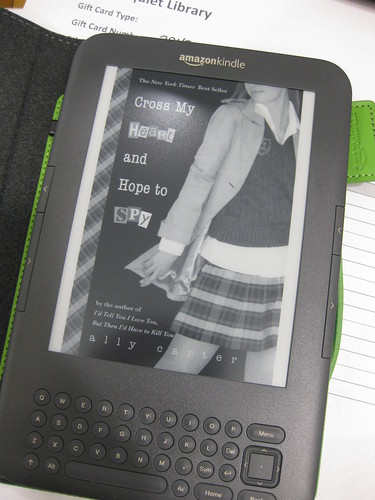
I feel so fortunate to have had a number of amazing opportunities to reflect on this year's experiment with eReaders in my library. Perhaps the most exciting is the one that's coming up on Monday when I get to spend an hour or so chatting about the marriage of eReaders and school libraries with my friend and hero Buffy Hamilton.  Seriously, if someone had told me a year ago that I'd be sharing a stage (even a virtual one) with Buffy, I'd never have believed it.  It's truly an honor to be included in this discussion at all, nevermind with the person I constantly try to model. Plus, it's hosted by little miss Daring Librarian herself, Gwyneth Jones.  Mind blowing.

Anyway, I really hope you'll join us!

Image from the UnquietLibrary Flickr Stream

Diving into Digital Books: Adding eReaders to Your School Library

Guests: Buffy J. Hamilton & Jennifer LaGarde
Host: Gwyneth Jones
May 2 - 8pm EST
Learn Central Page
Participant Link
Kindles, Nooks and iPads, Oh My! Implementing eReaders into your library program is about more than just jumping on the latest technological bandwagon or attempting to reinvent your library in order to stay relevant. It’s about good practice. Join Buffy Hamilton and Jennifer LaGarde as they discuss how eReaders have helped them provide students with a) access to the most up to date titles, b) the unique ability to efficiently link works of fiction with nonfiction resources and, c) the opportunity to interact with texts in ways that are simply not possible with traditional, library owned, books – all in an environment that both appeals to and enhances their skills as 21st century learners.

All materials, including my slideshare (which I'm proud to report contains only my own images) will be archived on the wiki once the session is complete.